Mix metal finishes by deciding what repeats
Different metal colors can sit in one outfit without every item matching exactly. A deliberate repetition can help the combination feel connected, but a single contrast can also be the point. Begin with the metal details already built into the clothes and bag.
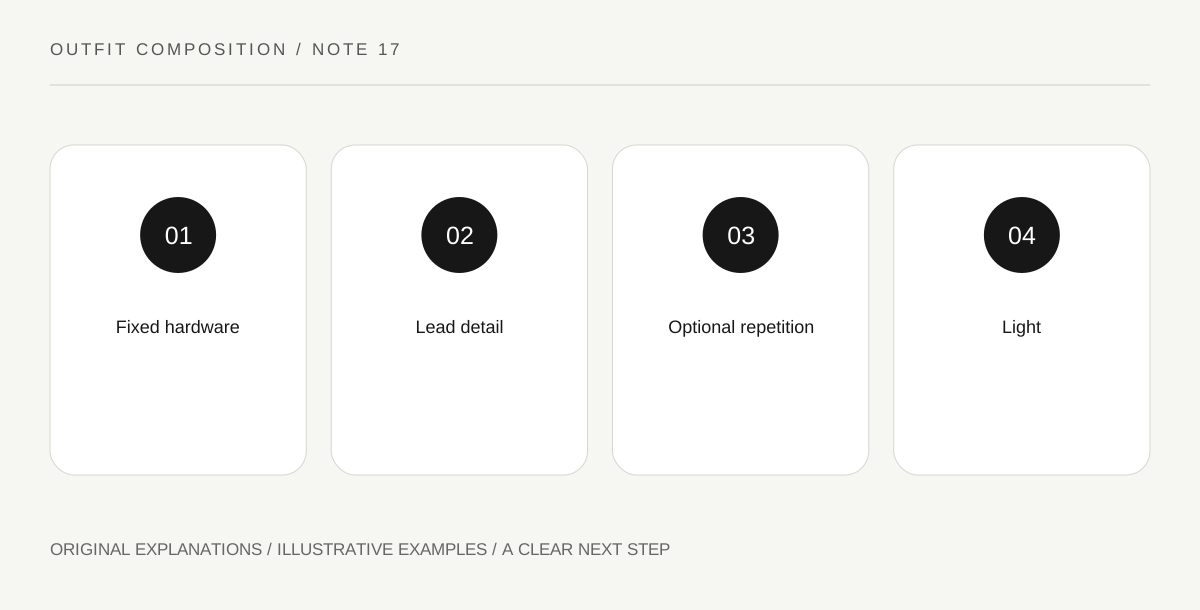
Original explanatory diagram. Read the full method and limitations below.
Inventory the fixed hardware
Look at visible buttons, zippers, buckles and bag hardware before choosing jewelry. Some details may be covered or too small to affect the overall impression. Record only the ones you can actually see at normal distance. A coat with bright buttons already contributes metal-colored areas, while a hidden trouser fastening may contribute almost none. This prevents a matching rule from forcing you to account for details that are effectively invisible.
Choose a lead finish if helpful
You might let the larger visible hardware establish one finish and use another in a smaller jewelry piece. Alternatively, a necklace can lead while garment hardware remains incidental. A lead is a compositional choice, not a requirement to make every metal item obey a strict ratio. Try the actual pieces together and notice which one attracts your attention first. The largest object is not always the most noticeable if another catches more light.
Repeat one relationship rather than every item
A two-tone piece can create a bridge, but you do not need to buy one to authorize the combination. Two small warm-colored details and one cooler detail may already produce a relationship you enjoy. Compare adding and removing one piece. The question is whether the repetition helps your intended outfit, not whether you can mathematically prove that the finishes are balanced. Personal preference can remain the deciding factor.
Separate appearance from material claims
A gold-colored or silver-colored finish does not by itself identify the metal content or how it should be cared for. Use the item’s actual information for cleaning and handling. For this styling exercise, describe the visible color, shine and shape without inventing a material identity. Finish by viewing the outfit in the lighting you expect, because reflective details can become more or less prominent as you move.
Illustrative worked example
Illustrative outfit: A navy jacket has bright silver-colored buttons, while the reader’s everyday watch has a warm-colored case. She first adds a large warm necklace, then compares a smaller one. She prefers the smaller piece because the jacket buttons remain the main repeated detail. Her note records the visible relationship rather than declaring that a particular metal combination is universally elegant or that the finish reveals the material’s value.
Questions that come up
Must I own a two-tone accessory to mix finishes?
No. It is one possible bridge, not a prerequisite. Existing pieces may already create the contrast or repetition you want.
Should every hidden fastening match?
Usually hidden details do not contribute much to the visible composition. Concentrate on what you can actually see and what matters to your own preference.
References and scope
These sources support the factual background. Examples and exercises are original illustrative teaching material. References do not imply endorsement.
- V&A Fashion collection — Primary visual references for examining silhouette, construction and decorative relationships; the styling exercises here are original.