Choose earrings by the space around the collar
An earring is seen alongside hair, neckline and collar rather than against an empty background. Study that local space before deciding whether a pair is too small, too large or too detailed. The useful comparison concerns the complete arrangement you want to wear.
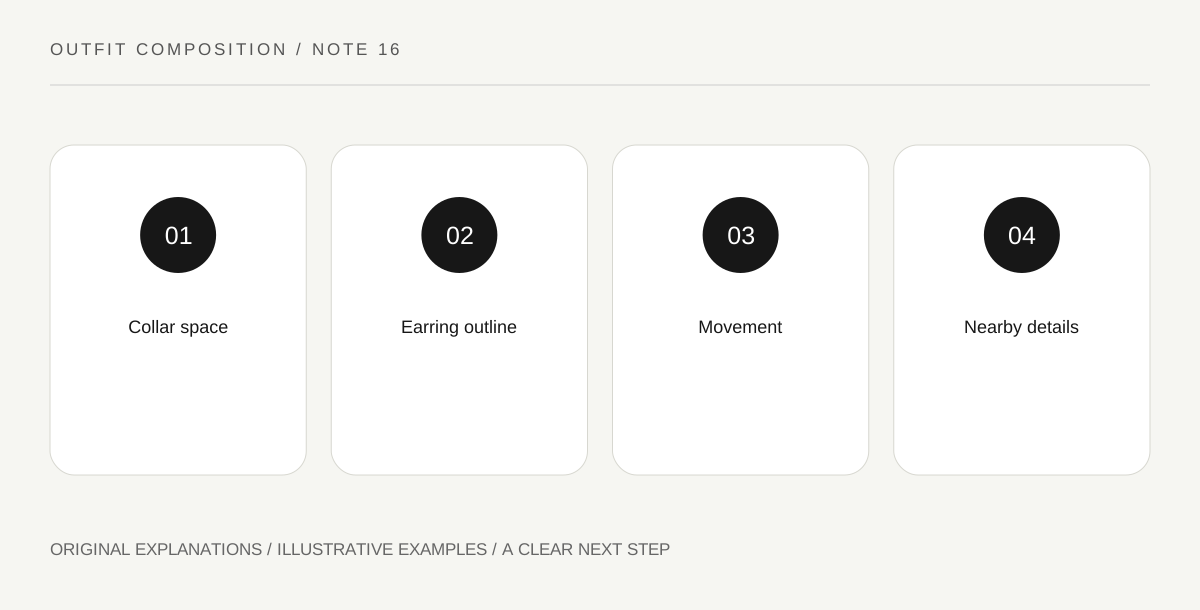
Original explanatory diagram. Read the full method and limitations below.
Observe the collar as a shape
A high closed collar creates a different surrounding area from an open shirt or a plain crew neck. Notice the points, curves and visible skin or base layer around it. These observations describe the garment, not a face-shape correction system. You do not need to classify your features into a fixed category to choose jewelry. Begin with what is actually close to the earrings in this particular outfit.
Compare outline before decoration
Try a simple round pair and a longer angular pair if you already own comfortable examples. Look at the broad shapes from conversational distance. A small intricate detail may disappear at that distance, while a plain silhouette remains visible. Neither is a failure; the effect depends on what you enjoy. Decide whether the earrings should create a distinct shape beside the collar or remain a quiet surface detail.
Assess movement and contact
Turn your head normally and put on the outer layer you expect to use. Notice whether earrings catch on the collar, scarf or hair, or feel uncomfortable during those actions. A still front view cannot show this. Do not choose a heavier pair solely to make the accessory more visible if you do not find it comfortable. The useful outfit includes the jewelry’s behavior as well as its outline. Comfort remains part of the accessory choice.
Choose the nearby details together
A necklace, decorative button and prominent earring can create a concentrated cluster. Compare the outfit with one nearby detail removed, then decide whether you prefer the quieter or busier arrangement. There is no required jewelry count. The aim is to see the cluster as a whole rather than judge each accessory separately and add them all because each is attractive on its own. Record the collar-and-earring pair you liked for future reference.
Illustrative worked example
Illustrative comparison: A reader wears a shirt with a broad pointed collar. Small round earrings create a quiet curved contrast, while long geometric earrings nearly meet the collar tips when she turns. She prefers the round pair for this shirt and keeps the longer pair for a different neckline. She then removes a necklace to see whether she likes the collar area better with fewer intersecting lines.
Questions that come up
Should earrings match my face-shape category?
You do not need a fixed category to make this choice. Compare the actual accessory, garment and your preference in the complete arrangement.
Are small earrings always less visible?
Not necessarily. Contrast, placement and surface can make a small pair noticeable. Judge the worn result rather than size alone.
References and scope
These sources support the factual background. Examples and exercises are original illustrative teaching material. References do not imply endorsement.
- V&A Fashion collection — Primary visual references for examining silhouette, construction and decorative relationships; the styling exercises here are original.