Make a drawstring waist part of the outfit’s visible structure
A drawstring can adjust a garment and create visible ends, gathers or a central detail. Start with a comfortable setting, then choose how much of that construction you want to show. The exercise treats function and appearance as connected decisions.
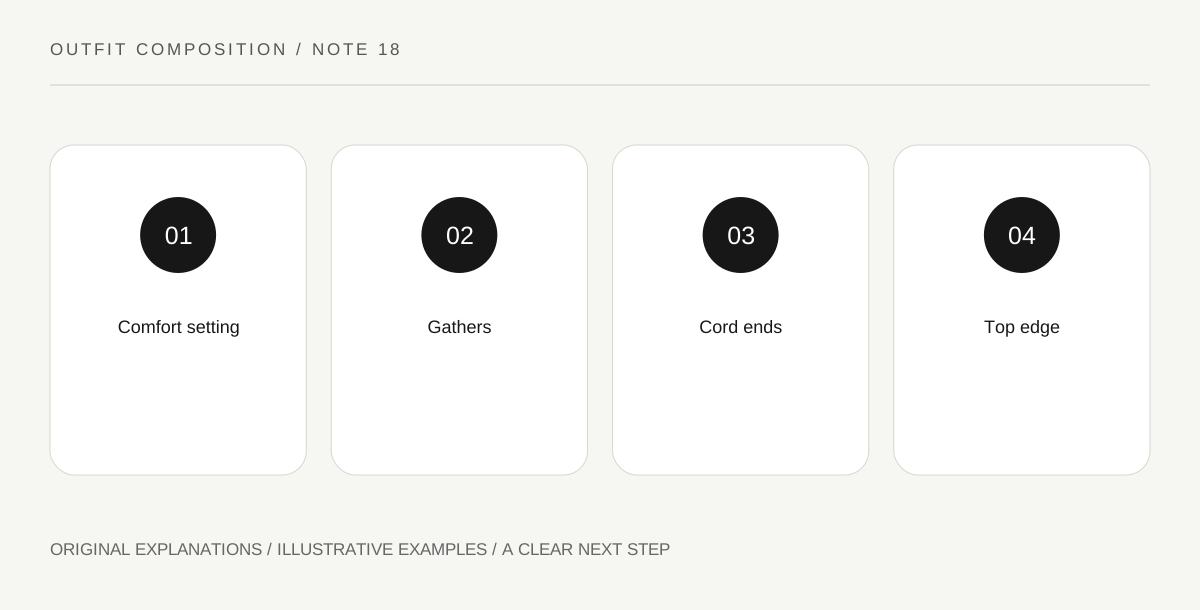
Original explanatory diagram. Read the full method and limitations below.
Set the garment for comfort first
Use the drawstring as designed and find a setting that allows the movement you need. A tight adjustment can change gathers, but it should not be used to force an unsuitable fit or create a preferred photograph at the expense of comfort. Check the waistband while seated as well as standing. If the underlying garment does not fit usefully, the cord may not be able to solve that problem by itself.
Observe where the gathers collect
Some drawstrings distribute fabric around the whole waist, while others concentrate it in one area. Look at the actual garment instead of assuming that every elastic or gathered waist behaves the same way. The gather pattern can be a feature you want visible or a functional detail you prefer to overlap. Neither choice is inherently neater. Decide which relationship works with the companion top you actually own.
Give the cord ends a clear plan
If the ends are meant to remain visible, observe their length and shape in the complete outfit. Avoid leaving them where they may catch or interfere with the day’s activities. Follow the garment’s intended fastening rather than inventing a complex knot that damages the cord or makes adjustment difficult. If a top covers the tie, check whether the knot forms a lump or changes how the top hangs.
Choose the surrounding edge
A shorter top can reveal the waistband and its adjustment detail. A longer layer can create a smoother upper field while the drawstring remains functional underneath. Compare both with the garment set at the same comfortable tension, so you are evaluating the top relationship rather than changing several variables at once. Walk and sit after each version. The preferred outfit is the one whose visible structure and everyday behavior both meet your needs.
Illustrative worked example
Illustrative comparison: A pair of soft dark trousers has a center drawstring and gathered waist. The reader sets the cord comfortably, then tries a short plain top that reveals the tie. A longer shirt hides it but catches on the knot. She chooses the short top for this combination and uses the garment’s intended tie arrangement, keeping the ends clear of her bag strap and other likely contact points.
Questions that come up
Does a drawstring make every waistband adjustable enough?
No. Adjustment range and the underlying cut vary. Choose a garment that fits your needs rather than expecting the cord to correct every fit issue.
Must the tie be hidden to look polished?
No. Visible construction can be deliberate. Decide whether the tie contributes to the composition you want and whether it behaves comfortably.
References and scope
These sources support the factual background. Examples and exercises are original illustrative teaching material. References do not imply endorsement.
- V&A Fashion collection — Primary visual references for examining silhouette, construction and decorative relationships; the styling exercises here are original.