Let barrel-leg trousers keep their curved outline
Barrel-leg trousers create volume through a leg line that widens and then narrows. Rather than trying to make them behave like straight trousers, observe where the curve comes from and choose a companion that lets you enjoy the actual silhouette.
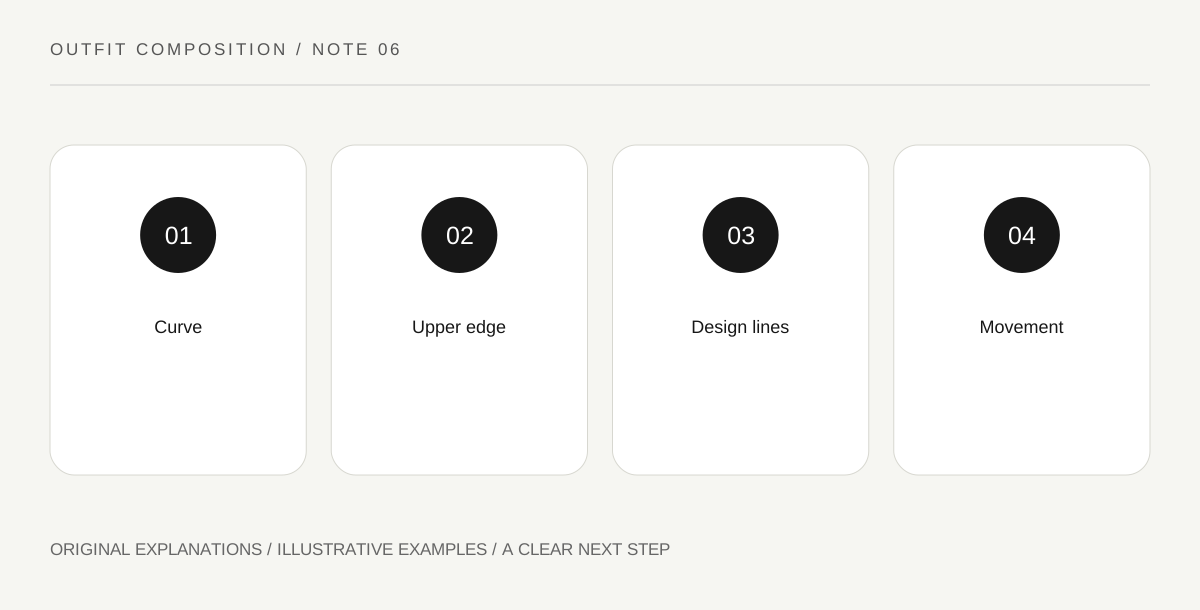
Original explanatory diagram. Read the full method and limitations below.
Find the curve in the worn garment
Look at the side seam, knee area and lower leg. A flat product image may exaggerate or hide the shape that appears when the trousers are worn. Some pairs have pronounced paneling; others produce only a gentle curve. Name where your pair is fullest and where it narrows. The garment’s pattern is the subject of this observation, not a judgment about the wearer’s legs or a project to disguise their body.
Choose the upper edge intentionally
A short straight top can leave the curved leg clearly visible from its starting point. A longer soft top can overlap the upper volume and create another shape. Compare the two arrangements without assuming that every full trouser needs a tight top. The actual fabric matters: a rigid shirt holds an edge, while a fluid one may follow the trousers more closely. Decide which relationship looks deliberate to you.
Notice pockets and seams as design lines
A large pocket or curved side seam may attract as much attention as the overall outline. Keep pocket contents realistic while trying the outfit. A phone can change how one side hangs, especially in a prominent pocket. If the seam is a feature you enjoy, a very busy companion may compete with it; if you enjoy complexity, that competition may be part of the effect. There is no obligation to minimize every visible detail.
Assess stride and seated comfort
Walk normally and sit in the intended outfit. Check whether the trousers allow your needed movement and whether the lower leg catches on the footwear. A dramatic silhouette is not evidence of comfortable fit. If the garment pulls at the waist or restricts the knee, reconsider the cut or seek appropriate fitting advice. The final outfit should preserve the curve you chose while allowing the ordinary actions of the day.
Illustrative worked example
Illustrative comparison: A pair of dark barrel-leg trousers has a visible curved seam and narrow ankle opening. The reader first tries a long draped top, then a shorter boxy one. She prefers the second because the seam remains easy to see. She adds her usual phone to the pocket, checks both sides and discovers that another pocket arrangement keeps the garment hanging more evenly during the activities she expects.
Questions that come up
Must barrel trousers be worn with a fitted top?
No. A boxy or fluid companion can work if you enjoy the resulting shape. Compare actual garments instead of treating volume as something that must always be reduced.
Can the leg shape change across sizes?
The worn shape can differ with fit and construction. Judge the specific pair on you rather than assuming a product photograph guarantees the same outline.
References and scope
These sources support the factual background. Examples and exercises are original illustrative teaching material. References do not imply endorsement.
- V&A Fashion collection — Primary visual references for examining silhouette, construction and decorative relationships; the styling exercises here are original.