Let a hoodie and blazer share the shoulder area comfortably
A hoodie beneath a blazer combines two familiar structures in one concentrated area: hood, collar, lapel and shoulder. Begin with space and movement, then judge the visual contrast. The combination works only if the actual layers feel comfortable together in ordinary use.
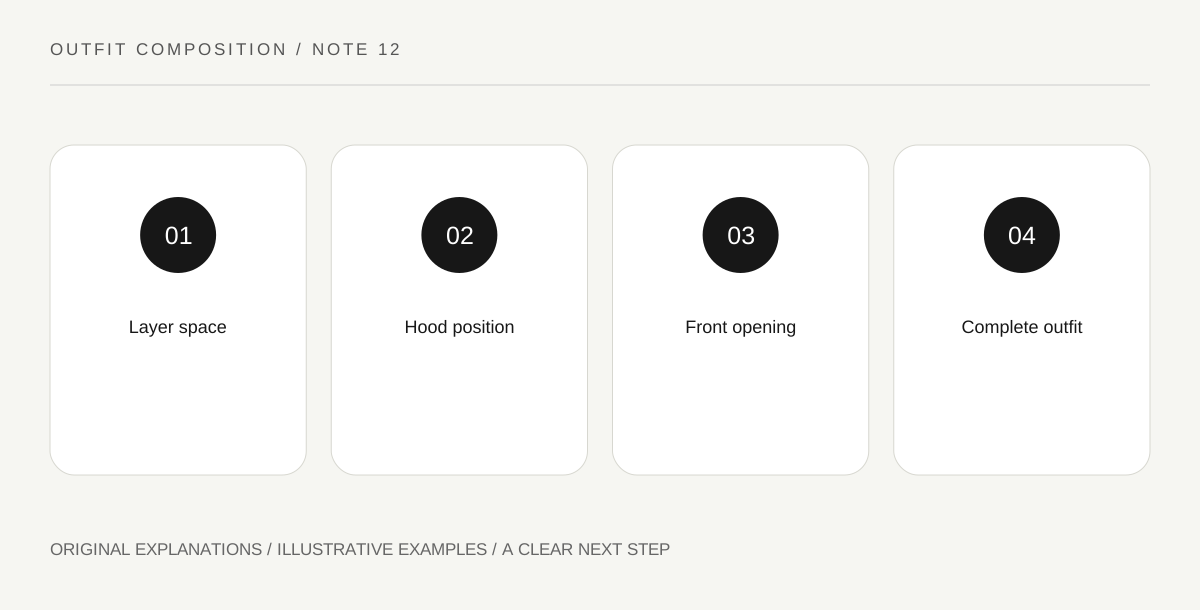
Original explanatory diagram. Read the full method and limitations below.
Choose layers with enough room
Try the hoodie under the blazer without forcing the shoulder or sleeve. A light-looking hoodie can still have bulky seams or a thick hood. Raise and lower your arms, reach forward and sit. If the blazer becomes restrictive, another size or cut may be needed; styling should not require tolerating pressure. The exercise concerns compatible garments rather than a rule that every tailored jacket can accommodate a hooded layer. Check the combination again after removing and replacing the outer layer.
Arrange the hood as a real object
Observe where the hood rests and whether it pushes the blazer collar into an uncomfortable position. Follow the garments' intended wearing construction rather than trapping the hood beneath a tight collar for a cleaner photograph. If the hood remains visible, it becomes part of the upper outline. A large hood can be a main feature, while a smaller one may read as a quieter edge behind the lapels.
Compare the central opening
An open blazer may frame the hoodie front, including its drawstrings, pocket or print. A closed blazer can cover much of that information and create a different shape. Decide which view you expect to use most. If a slogan is partly hidden, check whether you like the visible fragment. Do not assume that the whole design communicates simply because you know what the hidden words say.
Keep the rest of the outfit purposeful
A simple lower garment can let the layered shoulder area carry the interest, while another relaxed piece can continue the hoodie’s character. Choose footwear suited to your day, then look at the whole composition. The contrast between the garments does not require adding more sporty and tailored references everywhere. A useful note might identify the comfortable hoodie thickness, the blazer’s sleeve space and the preferred open-front view.
Illustrative worked example
Illustrative combination: A thin gray hoodie sits under a roomy dark blazer. The reader likes the hood’s clear outline but finds the drawstrings cross a printed detail awkwardly. She compares a plain-front hoodie already in her wardrobe and prefers the simpler center. After a seated and reaching check, she pairs the layers with straight trousers, allowing the shoulder-area contrast to remain the outfit’s main feature.
Questions that come up
Is this combination appropriate for every office?
No. Dress expectations vary. Consider the actual setting before assuming that a blazer makes every underlying garment suitable.
Does the hoodie need to be oversized?
No. Choose a cut and thickness that work comfortably under the particular blazer. A category label is less useful than the actual layered fit.
References and scope
These sources support the factual background. Examples and exercises are original illustrative teaching material. References do not imply endorsement.
- V&A Fashion collection — Primary visual references for examining silhouette, construction and decorative relationships; the styling exercises here are original.