Compose an outfit around tailored Bermuda shorts
Tailored Bermuda shorts combine a shorter lower garment with details often found in trousers: pleats, a waistband, pockets or a pressed-looking line. Start with those actual features, then choose whether the rest of the outfit continues the structure or introduces a softer contrast.
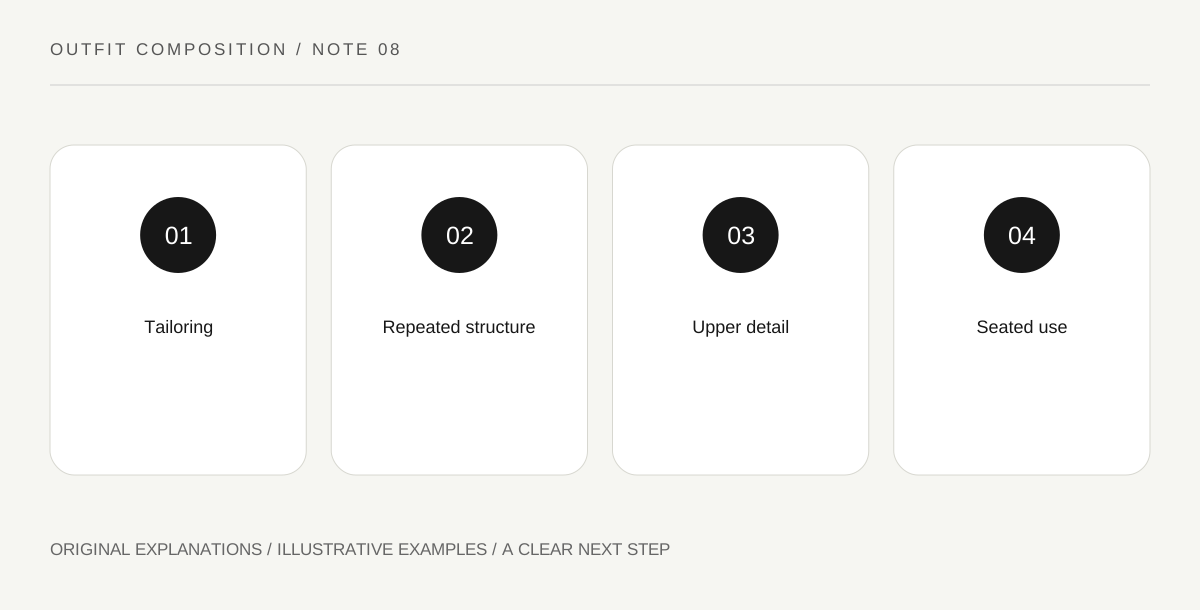
Original explanatory diagram. Read the full method and limitations below.
Read the shorts as a designed object
Look at the waistband, front closure, leg opening and visible seams. A broad opening creates a different shape from a close straight one. Some shorts have a strong fold; others rely on a smooth front. Name the feature you want to keep visible. Treating every pair as casual summer clothing can obscure the particular structure that made you choose this garment in the first place.
Decide how much tailoring to repeat
A structured jacket can extend the tailored language, while a simple knit can make the shorts' construction stand out by contrast. Try an existing jacket rather than assuming you need a matching suit. If the jacket covers nearly all the shorts, check whether that is the outline you intended. The relationship should be assessed from ordinary views and movement, not only a carefully arranged front-facing photograph.
Use the shirt front as a compositional choice
A visible placket, collar or smooth neckline changes the upper area around the shorts. You might prefer a plain upper field when the shorts have prominent pleats, or enjoy a repeated line from shirt buttons to trouser front. Keep the arrangement comfortable and stable. A styling choice that requires constant retucking or fastening adjustments may be less useful for a day with repeated sitting and standing.
Check sitting depth and pocket use
Sit on a chair similar to the one you expect to use and observe the garment’s comfort and coverage according to your preferences. Place ordinary small items in the pockets only if that is how you plan to wear them. A tailored appearance does not establish that the pockets are comfortable when loaded. Finish by choosing a shoe that serves the setting and your walking needs, then judge the whole outfit without imposing a single formality rule. Keep the seated arrangement comfortable rather than holding a special pose.
Illustrative worked example
Illustrative study: Charcoal Bermuda shorts with two front pleats are paired with a fine ivory knit. A matching-color jacket is added, but its length hides the pleats the reader wanted to feature. She compares a shorter existing jacket and prefers it. She then checks the shorts while seated and decides to carry her phone in a bag because the loaded front pocket changes the shape and feels uncomfortable.
Questions that come up
Do tailored shorts belong in every workplace?
No. Settings and dress expectations vary. Clarify the actual context instead of treating a tailored detail as automatic permission.
Must the jacket match exactly?
No. A separate jacket can create a deliberate relationship. Compare color, texture and length together rather than requiring a suit-like match.
References and scope
These sources support the factual background. Examples and exercises are original illustrative teaching material. References do not imply endorsement.
- V&A Fashion collection — Primary visual references for examining silhouette, construction and decorative relationships; the styling exercises here are original.