Use a leather-look skirt’s surface without building a costume
A leather-look skirt may introduce shine, stiffness or a strong seam pattern. Those features can be enough to make an outfit interesting without requiring every companion to share the same association. Begin with the surface you can see and the movement you can feel.
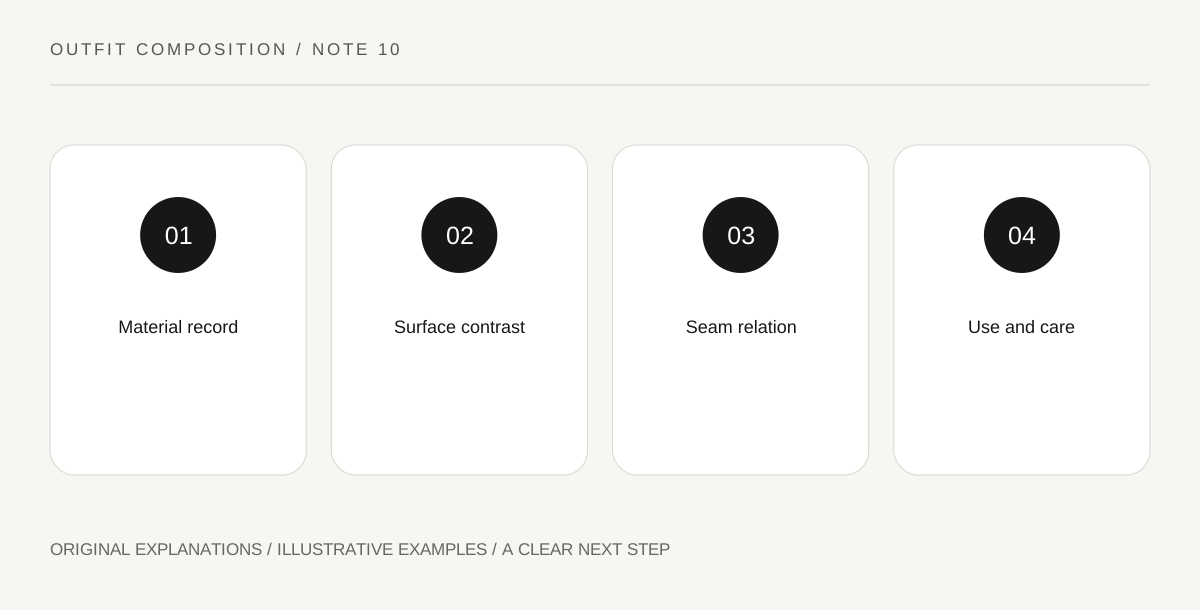
Original explanatory diagram. Read the full method and limitations below.
Separate appearance from material identity
A smooth dark surface can belong to different materials, and the shop’s style description may not explain its composition. Read the actual product information and care directions. For the composition exercise, describe visible features such as matte finish, glossy finish or prominent seams. This keeps a visual decision distinct from assumptions about durability, weather protection or the treatment the material can tolerate.
Choose the amount of surface contrast
A soft fine knit can sit quietly beside a firm smooth skirt. A crisp shirt introduces another structured surface. Compare both if they are already available. You do not need to call one feminine and the other masculine to describe the difference. Name the visible relationship: soft against firm, matte against reflective, fluid against held. These concrete observations make it easier to choose another companion later without relying on a whole themed outfit.
Let seams influence the surrounding lines
A central panel seam, exposed zipper or row of buttons can be a strong feature. Decide whether a nearby top edge repeats that line or crosses it. If the skirt has several prominent details, a plain upper garment may help you see them; a more complex upper garment may create an intentionally busy arrangement. Neither choice is automatically more sophisticated. Judge the result at a normal distance where the full outfit can be seen.
Assess sitting and walking before finalizing
Check the skirt’s stride, seated comfort and the way its surface interacts with the chair or bag you use. A still photograph cannot establish those behaviors. If the garment creases, shifts or catches in a way you dislike, consider another wearing arrangement or another skirt. Do not apply improvised heat, oil or household treatment to change the finish. Practical care belongs to the actual material and maker’s instructions, not the appearance category.
Illustrative worked example
Illustrative comparison: A matte black leather-look skirt has a central seam and an ordinary straight cut. The reader tries a soft cream knit and then a crisp striped shirt. She chooses the knit because it leaves the seam clearer and creates the surface contrast she enjoys. She checks the skirt seated at a table, then reads the care label before deciding how often the garment fits her regular clothing routine.
Questions that come up
Must I pair the skirt with boots?
No. Select footwear for your comfort, setting and preferred composition. The material association does not prescribe a single shoe category.
Can I care for every leather-look surface the same way?
No. Different constructions and coatings can require different handling. Follow the actual garment information rather than using a generic household treatment.
References and scope
These sources support the factual background. Examples and exercises are original illustrative teaching material. References do not imply endorsement.
- V&A Fashion collection — Primary visual references for examining silhouette, construction and decorative relationships; the styling exercises here are original.
- FTC Clothes Captioning — Garment care instructions and the importance of reading the complete care label.