Plan both faces of a reversible jacket
A reversible jacket offers two visible surfaces, but they may not behave like two unrelated jackets. Compare the complete outfit with each face outward, including cuffs, openings and closures. The useful result is a plan for how you actually change between the two versions.
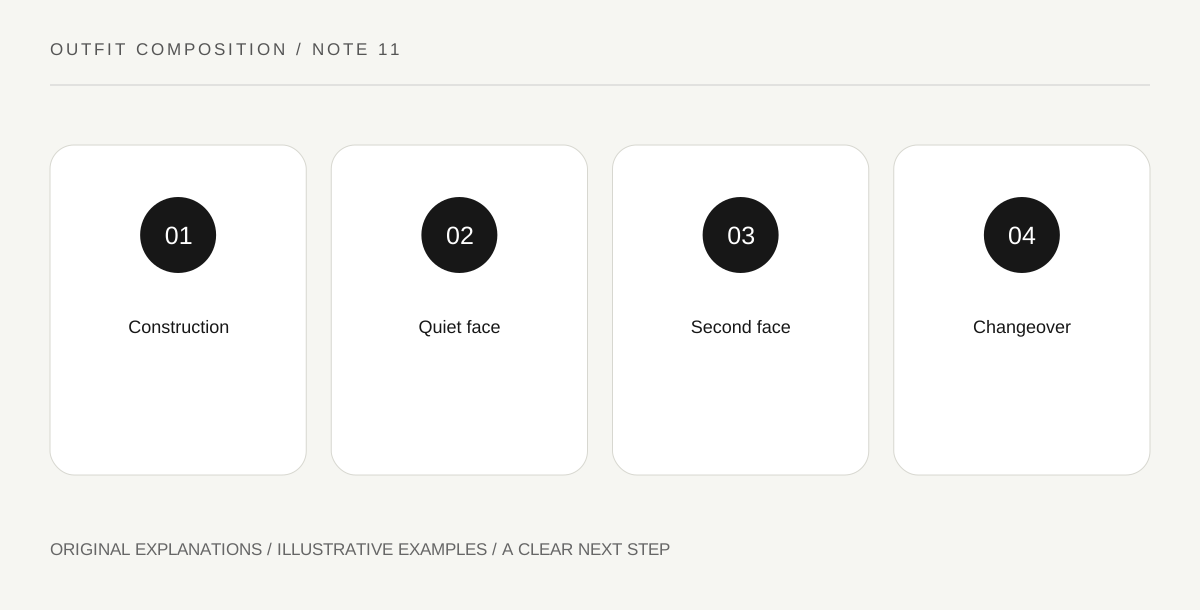
Original explanatory diagram. Read the full method and limitations below.
Identify the intended reversible construction
Check that the maker describes the jacket as reversible and learn how its fastenings and pockets work in both orientations. A decorative lining is not automatically a second wearing face. Look for labels, seam finishing and closure details without removing anything. This is a practical identification step, not a reason to alter the garment yourself. If one side’s intended use is unclear, ask before treating it as an alternative outer surface.
Compose one outfit around the quieter face
If one face is plain and the other patterned, begin with the plain side and an existing outfit. Notice the small parts of the reverse that remain visible at the opening or cuffs. Those glimpses can act as accents even when the main face is quiet. You do not need to repeat every color in the pattern. Choose whether the visible strip should be a small connection or an obvious contrast.
Turn the jacket without changing everything else
Keep the same base and reverse the jacket as intended. This reveals what the second face changes: the amount of pattern, the dominant color or the apparent outline. If the new version feels too busy for your taste, adjust one companion rather than buying an entirely separate set. A simple base may support both faces, but that is a possibility to test, not a guarantee made by the word reversible.
Check the changeover as a real action
Consider where you would reverse the jacket, what must leave the pockets and how closures behave afterward. A switch that looks effortless in a photograph may be inconvenient while carrying a bag. Read the complete care directions for the whole garment rather than treating each face as a separate fabric. Record which version you prefer for each situation, including whether a mid-day reversal is actually worth planning.
Illustrative worked example
Illustrative study: A jacket has a plain charcoal face and a pale geometric face. Over a simple black top and gray trousers, the charcoal side gives a quiet frame with a patterned cuff glimpse. Reversed, the jacket becomes the main feature. The reader likes both views but decides to choose the face before leaving home because the pocket changeover would be inconvenient during her commute.
Questions that come up
Does reversible mean twice as many complete outfits?
Not automatically. The two faces may support different combinations, but usefulness depends on whether you enjoy and can practically wear both.
Can I ignore one side’s care needs?
No. The garment is a combined construction. Use its complete care instructions rather than selecting a method only for the outward-facing surface.
References and scope
These sources support the factual background. Examples and exercises are original illustrative teaching material. References do not imply endorsement.
- V&A Fashion collection — Primary visual references for examining silhouette, construction and decorative relationships; the styling exercises here are original.
- FTC Clothes Captioning — Garment care instructions and the importance of reading the complete care label.