Choose closures around the way you actually get dressed
Buttons, zippers, hooks and ties can influence whether an outfit is convenient to wear. Begin with the dressing actions you find manageable, then compose around garments that support them. A visually appealing outfit becomes more useful when its closures work for your own routine.
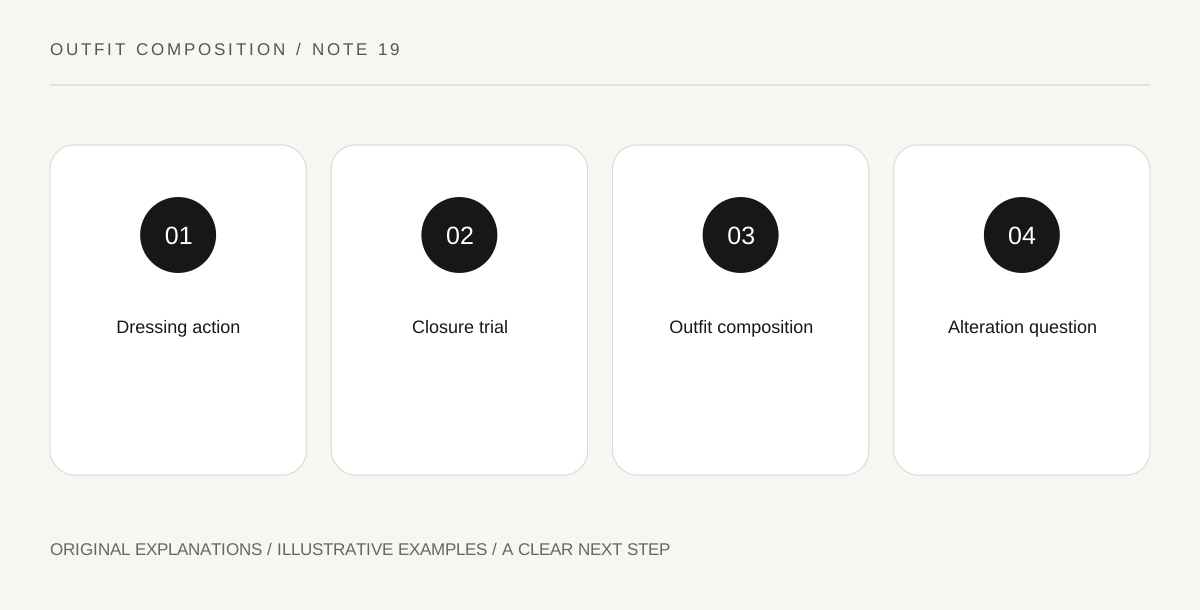
Original explanatory diagram. Read the full method and limitations below.
Describe the action that matters
Think about a real dressing moment: reaching a back zipper, fastening small buttons or adjusting a cuff. You do not need to assign a diagnosis to notice that one action is inconvenient. Make a concrete note such as front fastening easier to reach or small hooks take more time. This is a personal use observation rather than a claim that one closure type is universally accessible or appropriate for every reader.
Inspect the complete closure system
A large front zipper can still have an awkward starting position. A simple tie can involve several reaching and tensioning steps. Try the actual garment in a safe ordinary setting, with any assistance you normally choose. Check whether you can open it again when needed during the day. The ease of putting a garment on once does not automatically establish that bathroom breaks, outer-layer changes or end-of-day removal will be equally convenient.
Build the outfit from useful garments
Choose a base that already supports your dressing preferences. Then compare companions for color, surface and shape as you would with any other outfit. Practical needs do not require abandoning visual interest. A strong collar, a clear color field or an enjoyable texture can carry the composition while the closure arrangement remains manageable. Avoid adding a decorative layer that covers a fastening you need to reach repeatedly.
Seek appropriate alteration advice when needed
If a garment is otherwise useful but a closure is difficult, an experienced alteration professional may be able to discuss options. Do not assume every modification preserves fit, care or safe use. Explain the specific action you want to make easier and ask about the whole garment. Record the result as a decision about that item, not a universal solution. The goal is a wardrobe choice that respects both your preferred appearance and your practical autonomy.
Illustrative worked example
Illustrative wardrobe note: A reader likes the color and shape of two dresses. One has a difficult back fastening; the other has a manageable front closure. She chooses the second, pairs it with an existing textured jacket and keeps the closure reachable. For the first dress, she asks an alteration professional about options before deciding whether it belongs in her regular rotation. No modification is assumed to be suitable without inspection.
Questions that come up
Is this only relevant to adaptive clothing?
No. Anyone can have preferences about reach, grip, time or convenience. Start with your actual needs rather than a label attached to a garment category.
Can I replace every closure myself?
No. Construction, fit and material matter. Seek suitable guidance when a modification could affect the garment rather than assuming a simple swap always works.
References and scope
These sources support the factual background. Examples and exercises are original illustrative teaching material. References do not imply endorsement.
- V&A Fashion collection — Primary visual references for examining silhouette, construction and decorative relationships; the styling exercises here are original.